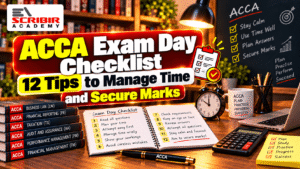
Preparing for an ACCA exam is not only about how much you know. How you manage your time, read the requirements, present your answers and use the exam system can make a major difference to your result. Even well-prepared students lose marks on exam day by misreading a requirement, spending too long on one question or skipping the final review.
This ACCA exam day checklist from Escribir Academy gives you a practical plan for better time management, sharper exam technique and more confidence when you click Start.

ACCA Exam Day Checklist at a Glance
- Read the requirement carefully before attempting the question
- Check your candidate and exam details
- Don’t spend too long on one difficult objective test question
- Use appropriate layouts for constructed-response answers
- Show calculations and workings clearly
- Keep written answers relevant to the requirement
- Manage your time according to the marks available
- Attempt every question where possible
- Leave time to review your exam
- Focus on securing marks, not producing a “perfect” answer
1. Read the Requirement Before Answering the Question
The most important ACCA exam technique is knowing exactly what the examiner is asking. Identify the requirement first, then read the scenario with that purpose in mind. Watch the instruction words, because they set the type and depth of answer:
Calculate, Explain, Discuss, Evaluate, Recommend, Identify, Compare, Justify
If the question asks you to identify two issues, several paragraphs on the whole topic waste time. If it asks you to evaluate, a list of definitions will not earn the marks.
Exam-day tip: ask yourself, “What exactly do I need to produce to earn these marks?”
2. Check Your Exam Details Carefully
At the start of the exam, check the information on screen, confirm you are sitting the correct paper and follow all instructions from the exam centre and the exam system. Don’t rush the opening screens because you are nervous.
You should already know the computer-based exam (CBE) environment from ACCA’s practice and specimen resources. Knowing how to navigate, flag questions and monitor progress saves valuable time.
3. Don’t Get Stuck on One MCQ or Objective Test Question
A hard objective question can easily eat more time than it deserves. “Just another minute” quickly becomes five. If you are unsure, make your best attempt, flag the question and move on. You can return to it if time allows.
Protect your exam time. One difficult question should not damage the rest of your paper.
4. Manage Your Time According to the Marks Available
Time management is one of the most important skills in any ACCA exam. The marks for a requirement should guide how long you spend on it. Know the structure of your specific paper and build a realistic time plan before exam day.
During the exam, check regularly:
- How much time is remaining
- How many questions are still incomplete
- Whether you are spending too long on one section
- Whether your answer length matches the marks available
Strong students sometimes write too much early on and then rush the final questions. Be disciplined.
5. Use the Correct Layout for Constructed-Response Questions
For constructed-response questions, presentation makes your answer easier to mark. Where appropriate, use headings, short paragraphs, tables, clearly labelled calculations and structured recommendations. If the question asks for a report, memo or other specific format, follow it closely.
Your goal is an answer that is clear, relevant, professional and easy to follow.
6. Show Your Workings Clearly
Don’t focus only on the final number. Show and label your workings, such as Revenue, Variable Cost, Contribution, Discount Factor, Present Value and Working Capital, so markers can follow your method.
Clear workings also help you spot your own mistakes during review. Even if your final figure is wrong, a logical approach lets the marker award method marks under the marking scheme.
7. Keep Theory Answers Relevant and Focused
Writing more does not automatically earn more marks. One of the most common ACCA exam mistakes is a long theory answer that never addresses the scenario. Instead:
- Identify what the question is asking.
- Select the relevant knowledge.
- Apply it to the scenario where required.
- Explain your point clearly.
- Move on to the next valid point.
A useful rule: one clear point plus relevant explanation or application beats a paragraph of unrelated theory.
8. Attempt Every Question Where Possible
A blank answer earns nothing. Even when you are unsure, you may be able to offer a relevant calculation, formula, definition, logical point or scenario-based recommendation. Collect marks across the whole paper rather than perfecting one answer.
9. Save Time to Review Your Exam
If timing allows, reserve a short period at the end. Many students find around 10-15 minutes useful, though the right amount depends on your paper and its duration. Check for:
- Unanswered and flagged questions
- Missing requirements
- Calculation errors and incorrect signs or figures
- Typing mistakes and incomplete sentences
- Missing conclusions or recommendations
- Answers that don’t address the requirement
Don’t spend your last minutes rewording acceptable answers. Prioritise corrections that protect or gain marks.
10. Get Comfortable with the ACCA CBE Interface
Practise in ACCA’s exam environment before the live sitting so that navigation feels familiar. Be comfortable with moving between questions, viewing remaining time, flagging questions, and using the word-processing and spreadsheet response areas. On exam day you should be thinking about the answer, not discovering how the software works.
11. Don’t Chase Perfection
ACCA exams reward enough marks across the whole paper. If you keep rewording a reasonable answer while another requirement sits untouched, that is a poor trade-off. Answer the requirement. Secure the available marks. Move forward. Return later if time remains.
12. Stay Calm When You See a Difficult Question
Almost every candidate meets a question that feels unfamiliar. Don’t conclude “I can’t do this exam.” Read the requirement, break the question into parts and ask what you can answer. There are often marks for straightforward calculations, basic principles, relevant observations and logical recommendations. One hard question does not decide your exam.
Common ACCA Exam-Day Mistakes to Avoid
- Spending too long on one question: it creates time pressure across the paper.
- Ignoring the requirement: correct information that doesn’t answer the question earns few marks.
- Writing too much theory: focus on relevance and application.
- Hiding your calculations: keep workings clear and logical.
- Leaving questions blank: always give yourself a chance to earn marks.
- Poor time management: allocate time by marks and paper structure.
- Not practising the CBE environment: learning software mid-exam adds pressure.
- Panicking after one difficult question: move on and return later.
The Night Before Your ACCA Exam
Don’t try to relearn the syllabus. Instead:
- Review key formulas and important formats
- Revisit your common mistakes
- Check your exam arrangements
- Prepare permitted identification and required items
- Review your exam strategy
- Get proper rest
ACCA Exam Morning Checklist
Check ACCA’s latest candidate instructions for your exam and centre, then confirm you have:
- Required identification
- Exam booking details
- The correct location and reporting time
- Any permitted equipment
- Travel arrangements sorted
Arriving rushed and stressed hurts concentration before you even begin.
How to Improve Your ACCA Exam Technique Before Exam Day
Exam technique is built through practice, not discovered in the final five minutes of the real exam. Before your sitting, practise:
- Timed questions within realistic exam limits
- Full mock exams under timed conditions (try our ACCA mock exams)
- Constructed responses in an exam-style computer environment
- Question debriefing: after each question ask whether you understood the requirement, managed your time, structured the answer, applied your knowledge, showed clear workings, and where you lost marks
Knowledge + Exam Technique = Better ACCA Preparation
Passing ACCA combines technical knowledge, question practice, exam technique, time management and attention to detail. You may know the syllabus well, but if you can’t apply it within the time available, your result won’t reflect your ability.
Prepare for Your ACCA Exams with Escribir Academy
At Escribir Academy, ACCA preparation goes beyond finishing the syllabus. Students get structured learning, question practice, mocks, revision classes and exam-focused guidance from experienced ACCA faculty. Whether you are preparing for:
- Financial Reporting (FR)
- Taxation (TX)
- Performance Management (PM)
- Audit & Assurance (AA)
- Financial Management (FM)
- Strategic Business Leader (SBL)
- Strategic Business Reporting (SBR)
- Advanced Audit & Assurance (AAA)
- Advanced Financial Management (AFM)
- Advanced Performance Management (APM)
- Advanced Taxation (ATX)
the aim is the same: understand the concepts, practise exam-standard questions, develop your technique and walk into the exam with a clear strategy. Explore ACCA courses at Escribir Academy, from Applied Knowledge and Applied Skills to Strategic Professional.
Final ACCA Exam Day Checklist
Before clicking Start, remember:
- ✓ Read the requirement carefully
- ✓ Understand what the question is asking
- ✓ Watch the marks and manage your time
- ✓ Don’t get stuck on one objective question
- ✓ Keep calculations and workings clear
- ✓ Structure constructed responses appropriately
- ✓ Keep written answers relevant
- ✓ Attempt every question where possible
- ✓ Review incomplete or flagged questions
- ✓ Use your final minutes wisely
- ✓ Stay calm when a question feels difficult
- ✓ Focus on earning marks, not a perfect exam
Trust your preparation. Passing ACCA is not only about knowledge. It is about applying that knowledge under exam conditions. Escribir Academy wishes everyone sitting their ACCA exams the best of luck.
Related ACCA Reading from Escribir Academy
- ACCA December 2026 Exam Dates, Deadlines and Study Plan
- Why Mocks Matter Before Your ACCA Exam
- Active Learning Strategies for ACCA Exams
- Staying Motivated During ACCA Exams: Tips for Success
- Key Challenges of ACCA Students and How to Overcome Them
Frequently Asked Questions About ACCA Exam Day
What should I do first when I see an ACCA exam question?
Read the requirement carefully so you know exactly what the examiner expects. Then read the scenario or supporting information with that requirement in mind.
Should I attempt every question in an ACCA exam?
Where possible, yes. A blank answer can’t earn marks. Manage your time so you can attempt as much of the paper as you can.
How much time should I keep for reviewing my ACCA exam?
There is no universal figure, but around 10-15 minutes works for many students, provided it fits the structure and duration of their paper.
Should I show workings in ACCA calculation questions?
Yes, where appropriate. Clearly labelled workings show your approach and make your answer easier for markers to follow.
Are long answers better in ACCA exams?
Not necessarily. Your answer should match the requirement and the marks available. Focused, relevant points usually beat long answers full of unrelated information.
How can I practise ACCA computer-based exams?
Use ACCA’s Practice Platform, specimen exams, mock exams and other official resources so the CBE environment feels familiar before your live exam.
What is the best ACCA exam strategy?
No single strategy suits every paper or student. A strong approach means understanding the exam structure, allocating time by marks, answering the requirement directly, avoiding excessive time on hard questions and leaving time to review.